
Horizontal Screw Conveyor: How Do You Choose the Right One?
Selecting a horizontal screw conveyor often starts with a one-line request: "I need 5 tons per hour over 6 meters — what's the price?" That message looks harmless. It hides almost every variable that decides whether the machine runs smoothly or plugs on day two. Many buyers learn this only after installation. I handle these inquiries daily, and this guide shares the questions that prevent expensive mistakes.
A horizontal screw conveyor moves bulk material along a level or near-level path using a rotating helical screw inside a trough. Correct selection is a risk-control decision, not a catalog lookup: it depends on material behavior, feeding conditions, duty cycle, and special requirements such as wear, corrosion, sealing, hygiene, or explosion protection. Capacity and length alone are not enough.
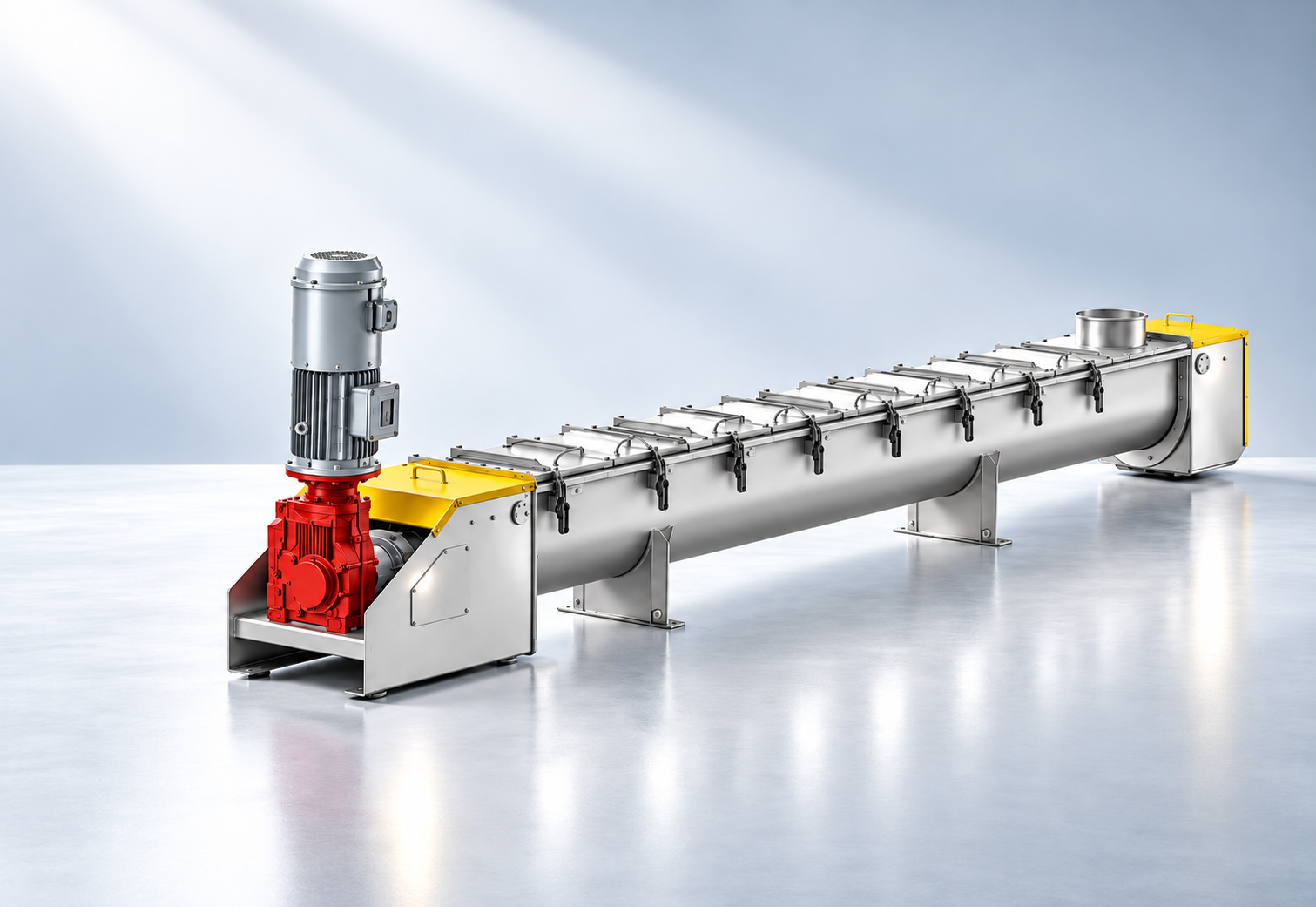
In the sections below, I walk through each clarification step in the order I use with overseas buyers. Every question comes from real projects. Answer them before you request a quotation, and you will receive a selection you can actually trust.
What Is a Horizontal Screw Conveyor, and When Does It Fit?
Buyers often assume one conveyor type covers all duties. Then a horizontal unit gets asked to lift material, or a standard screw gets blamed for problems caused by sticky buildup. Getting the basic definition right first saves weeks of misdirected quotations.
A horizontal screw conveyor moves bulk material along a level or gently inclined route using a rotating helical screw inside a trough. It suits powders, granules, flakes, and semi-moist materials when the layout allows a straight, low-profile path. As the conveying angle increases, usable capacity generally decreases, so steeper routes usually call for an inclined or vertical design instead.
A horizontal screw conveyor is simple in principle but highly configurable in practice. A motor drives a rotating screw shaft; the helical flights catch material at the inlet and push it along the trough to the discharge. Because every element of that machine can change, two conveyors with the same length and the same capacity figure can differ more than two entirely different machine types.
The main configuration choices include:
| Element | Common options | Why the choice matters to you |
|---|---|---|
| Trough | U-type, V-type, O-type (pipe) | Openness, dust sealing, and containment differ |
| Flight | Standard screw, paddle, ribbon | Sticky or cohesive materials often need ribbon or paddle flights |
| Shaft | Single-shaft, multi-shaft, shaftless | Sticky, stringy, or high-moisture materials may need shaftless designs |
| Construction material | Carbon steel, stainless steel, duplex steel, titanium | Corrosion, hygiene, and process temperature drive the selection |
| Process function | Heating or cooling jacket | Temperature control during conveying changes the structure |
I recently handled an inquiry that said only "conveyor for powder, 4 meters." During clarification, the buyer mentioned a hygiene requirement and daily wash-downs. The machine moved from a carbon-steel open trough to a polished stainless pipe body with special seals. The capacity and the length never changed. The machine did.
This is why I never treat a horizontal screw conveyor as an interchangeable standard product. The working principle is universal, but the construction follows your material and your site. A supplier who quotes a fixed model number from two data points is guessing.
Why Are Capacity and Length Not Enough to Select a Horizontal Screw Conveyor?
An inquiry like "5 t/h, 8 m, ash" looks complete. It is not. The same material name can describe a free-flowing dust or a damp, sticky batch. Quoting from that single line is how buyers end up with a machine that plugs on the second day.
Capacity, length, and a material name provide only the frame of a selection. Bulk density, particle size, flowability, moisture, and stickiness change filling behavior, power demand, and blockage risk. A larger screw diameter also does not guarantee higher usable capacity on its own. Reliable sizing requires material behavior plus feeding and operating conditions.
Every material property below changes the machine, not just the number on the drawing:
- Bulk density links your mass capacity to the volumetric capacity the screw must physically move. Light, fluffy materials need more cross-section than heavy minerals for the same tonnes per hour.
- Particle size and distribution affects inlet bridging, flight clearance, and the risk of material jamming between the screw and the trough.
- Flowability decides how much of the trough cross-section the material fills. Poorly flowing material fills less and behaves differently at the discharge.
- Moisture and stickiness determine whether material builds up on the flights, the shaft, and the trough walls. Sticky material can stop a conveyor that is perfectly correct on paper.
- Abrasiveness wears flights and trough walls, and it may justify a wear-resistant structure or liners.
- Corrosiveness drives construction toward stainless, duplex, or titanium.
A buyer in the Middle East once asked me for "a screw conveyor for sand, 10 t/h." I asked for a photo and the moisture content. The material turned out to be dewatered sludge with high water content. That is not sand. The correct machine needed a different flight geometry, a different trough, and a more generous power margin. The original inquiry would have produced a guaranteed failure.
Does a bigger screw diameter mean more capacity?
Not automatically. A larger diameter only raises usable capacity when the feed keeps up, the material loads the cross-section properly, and the operating conditions allow it. Buyers often request a larger diameter as insurance. However, an oversized screw running half-empty wears unevenly, handles surges poorly, and still plugs if the material itself is the problem. The diameter works only as part of a complete equipment design.
One note on my perspective: my experience is sales-side technical clarification on real projects, not laboratory testing. I use it to help buyers frame complete questions. The final selection still deserves verification by a qualified process engineer on your side.
How Do Feeding Conditions and Duty Cycle Affect Real Performance?
Two buyers can request the same capacity on paper. One feeds the conveyor through a controlled volumetric feeder. The other drops material in by front loader. The first machine runs for years. The second overloads every afternoon. The difference never appeared on the data sheet.
Feeding method, duty cycle, and loaded starts decide whether nominal capacity becomes usable capacity. A flooded inlet, a surge feed, or a required start with the trough full changes power sizing and design margins. Before you accept any capacity figure, confirm how material enters, how long the conveyor runs, and whether it must start under load.
Feeding is the most underestimated factor in horizontal conveying. A screw conveyor moves what arrives at the inlet. If the inlet receives a controlled, metered flow, the machine performs close to its calculated duty. If the inlet is flooded, the material fills the trough as much as the geometry allows, and the screw conveys whatever its speed and fill conditions permit. Those are two different machines carrying the same nameplate.
The operating conditions I confirm with every buyer include:
- Feeding method. Is material metered by a feeder, a rotary valve, or a preceding process? Or does it flood in from a hopper or a loader?
- Duty cycle. Does the conveyor run continuously for days, or only a few batches per day?
- Loaded starts. Must the machine restart with a full trough after a power cut? This affects power sizing directly.
- Feed surges. What happens upstream when a batch dumps or a silo discharges suddenly?
- Downstream tolerance. Can the next process accept short flow variations, or must the conveyor buffer them?
I once received a capacity specification that made sense until the buyer mentioned power outages every other day. The plant required loaded restarts, because the trough could not be drained manually. The motor sizing changed, and so did the quotation. Nothing about the material had changed at all.
Also consider whether the conveyor might become your line's bottleneck. If upstream capacity grows, or if the feed fluctuates, the machine that was correctly sized yesterday becomes the restriction tomorrow. State your expected peak, not only your average, when you specify.
Which Special Requirements Change the Design of a Horizontal Screw Conveyor?
The cheapest quotation usually assumes a carbon steel trough, a simple cover, and a clean, dry material. Your plant may need none of that. Hygiene rules, corrosive chemistry, dust containment, or explosion protection can change the material, the seals, the surface finish, and the price — by multiples, not percentages.
Wear, corrosion, sealing, hygiene, and explosion-protection requirements change the material and structural solution of the machine. Stainless, duplex, or titanium construction, special seals, polished surfaces, and certified components replace standard parts. Declare these requirements early, because they affect design, manufacture, and documentation. Ask to verify certificates as documents, not as claims.
The table below shows how a single requirement can rewrite an entire specification:
| Your requirement | Typical design response | What you should verify as a buyer |
|---|---|---|
| Abrasive material | Thicker flights, wear-resistant structure, replaceable wear parts | Wear part specification and drawings |
| Corrosive material | Stainless steel, duplex steel, or titanium construction | Material certificates matching the confirmed grades |
| Dust containment | O-type pipe trough, special shaft seals | Seal type and expected leakage behavior |
| Hygiene (food, pharma) | Stainless construction, polished welds, cleanable geometry | Surface finish specification and weld records |
| Explosion protection | Certified components, design per applicable directives | The actual certificate documents, not verbal assurance |
| Temperature control | Heating or cooling jacket | Process medium, connections, and thermal requirements |
A food-plant buyer once assumed that "stainless steel" covered everything. It did not. The project needed a defined surface finish, smooth welds, and seals suitable for wash-down chemicals. Each line item appeared only because we asked the question early, before the drawings were fixed.
I treat certifications as documents the buyer should verify. Ask for the certificate number and the issuing body, and match it against the confirmed technical documents. A supplier who cannot produce the document on request is asking you to trust a claim. For safety-relevant or highly corrosive applications, have the final design reviewed by a qualified process engineer before you sign.
What Can Factory Testing Verify Before Your Horizontal Screw Conveyor Ships?
After weeks of drawings and emails, buyers want proof. Some expect a running video to demonstrate capacity. It cannot. Knowing exactly what a factory test verifies, and what it cannot, keeps your acceptance process honest and your warranty position enforceable.
A no-load test verifies basic mechanical operation: correct rotation, stable motor current, acceptable alignment and vibration, no abnormal noise, and dimensions and configuration matching the confirmed drawings. It cannot verify loaded conveying capacity with your material, because the factory does not run your product. Loaded performance is confirmed at commissioning on your site.
In our workshop, every finished conveyor goes through the same sequence: appearance inspection, verification of main dimensions and configuration against the confirmed documents, a manufacturing quality check, and an empty running test. For remote acceptance, we provide complete machine photographs, detail photographs, and a no-load running video. Additional inspection records and material certificates follow the customer's contract requirements.
A no-load test can confirm:
- Rotation direction and drive function;
- Motor current and general running behavior;
- Absence of abnormal noise, vibration, or mechanical interference;
- Overall dimensions, inlet and outlet positions, and configuration;
- Visible manufacturing quality on the finished machine.
A no-load test cannot confirm:
- Capacity with your actual material;
- Blockage behavior, buildup, or wear tendency;
- Sealing performance under real dust or gas load;
- Behavior under your feeding and duty conditions.
A no-load video proves the machine turns. It does not prove your material flows.
This distinction protects both sides. If a problem appears at commissioning, clear factory records help determine whether the cause lies in manufacturing, installation, or operation. If the factory test reveals an issue, the machine is corrected first; the buyer then receives a rectification report and confirms it before final payment and shipment.
If your project requires third-party inspection or specific test records, agree on them before production starts. Retrofitting documentation into a finished process is far harder than specifying it in the contract.
Frequently Asked Questions
How much does a horizontal screw conveyor cost?
Price depends on confirmed material behavior, capacity, length, angle, inlet and outlet configuration, construction material, and special requirements. No responsible supplier can produce a reliable quotation from capacity and length alone. Provide the full operating picture first, then compare quotations on the same technical basis.
Can a horizontal screw conveyor work on an incline?
A gently inclined route still behaves close to horizontal, but usable capacity generally decreases as the angle grows, and the effect depends on your material. Steeper routes usually call for an inclined or vertical design. State your actual angle and elevation difference, and let the supplier confirm the right configuration.
What information should I prepare before requesting a quotation?
Prepare the material and its key properties, target capacity, conveying distance and angle, inlet and outlet arrangement, preferred construction material, special requirements, number of units, installation country, and expected timeline. A photo of the material or the installation site also helps clarify behavior quickly.
Does a no-load running video prove conveying capacity?
No. A no-load test verifies mechanical operation, dimensions, and configuration only. Loaded capacity depends on your material, feeding, and duty conditions, and it can only be confirmed at commissioning with your product. Treat capacity claims backed only by an empty running video with caution.
Can a horizontal screw conveyor handle sticky, abrasive, or corrosive materials?
Custom designs can address them: ribbon or paddle flights, shaftless screws, wear-resistant structure, or stainless, duplex, and titanium construction. The exact solution depends on the specific material behavior. For critical applications, have the final selection reviewed by a qualified process engineer.
Conclusion
Choosing a horizontal screw conveyor is a risk-control decision, not a catalog lookup. Capacity and length frame the project, but material behavior, feeding conditions, duty cycle, and special requirements decide whether the machine actually performs on your site. Confirm all of them in writing before you accept any quotation, and verify what factory tests can and cannot prove. We build custom complete screw conveyors for overseas projects, and our process starts with a technical checklist and an outline drawing that you confirm before any price becomes final. If you are evaluating a horizontal screw conveyor for your plant, send us your material details and operating conditions — we will ask the right questions next.
Horizontal Screw Conveyor: How Do You Choose the Right One?
Selecting a horizontal screw conveyor often starts with a one-line request: "I need 5 tons per hour over 6 meters — what's the price?" That message looks harmless. It hides almost every variable that decides whether the machine runs smoothly or plugs on day two. Many buyers learn this only after installation. I handle these inquiries daily, and this guide shares the questions that prevent expensive mistakes.
A horizontal screw conveyor moves bulk material along a level or near-level path using a rotating helical screw inside a trough.1 Correct selection is a risk-control decision, not a catalog lookup: it depends on material behavior, feeding conditions, duty cycle, and special requirements such as wear, corrosion, sealing, hygiene, or explosion protection. Capacity and length alone are not enough.
In the sections below, I walk through each clarification step in the order I use with overseas buyers. Every question comes from real projects. Answer them before you request a quotation, and you will receive a selection you can actually trust.
What Is a Horizontal Screw Conveyor, and When Does It Fit?
Buyers often assume one conveyor type covers all duties. Then a horizontal unit gets asked to lift material, or a standard screw gets blamed for problems caused by sticky buildup. Getting the basic definition right first saves weeks of misdirected quotations.
A horizontal screw conveyor moves bulk material along a level or gently inclined route using a rotating helical screw inside a trough. It suits powders, granules, flakes, and semi-moist materials when the layout allows a straight, low-profile path. As the conveying angle increases, usable capacity generally decreases2, so steeper routes usually call for an inclined or vertical design instead.
A horizontal screw conveyor is simple in principle but highly configurable in practice. A motor drives a rotating screw shaft; the helical flights catch material at the inlet and push it along the trough to the discharge. Because every element of that machine can change, two conveyors with the same length and the same capacity figure can differ more than two entirely different machine types.
The main configuration choices include:
| Element | Common options | Why the choice matters to you |
|---|---|---|
| Trough | U-type, V-type, O-type (pipe) | Openness, dust sealing, and containment differ |
| Flight | Standard screw, paddle, ribbon | Sticky or cohesive materials often need ribbon or paddle flights |
| Shaft | Single-shaft, multi-shaft, shaftless | Sticky, stringy, or high-moisture materials may need shaftless designs |
| Construction material | Carbon steel, stainless steel, duplex steel, titanium | Corrosion, hygiene, and process temperature drive the selection |
| Process function | Heating or cooling jacket | Temperature control during conveying changes the structure |
I recently handled an inquiry that said only "conveyor for powder, 4 meters." During clarification, the buyer mentioned a hygiene requirement and daily wash-downs. The machine moved from a carbon-steel open trough to a polished stainless pipe body with special seals. The capacity and the length never changed. The machine did.
This is why I never treat a horizontal screw conveyor as an interchangeable standard product. The working principle is universal, but the construction follows your material and your site. A supplier who quotes a fixed model number from two data points is guessing.
Why Are Capacity and Length Not Enough to Select a Horizontal Screw Conveyor?
An inquiry like "5 t/h, 8 m, ash" looks complete. It is not. The same material name can describe a free-flowing dust or a damp, sticky batch. Quoting from that single line is how buyers end up with a machine that plugs on the second day.
Capacity, length, and a material name provide only the frame of a selection. Bulk density, particle size, flowability, moisture, and stickiness change filling behavior, power demand, and blockage risk. A larger screw diameter also does not guarantee higher usable capacity on its own. Reliable sizing requires material behavior plus feeding and operating conditions.
Every material property below changes the machine, not just the number on the drawing:
- Bulk density links your mass capacity to the volumetric capacity the screw must physically move. Light, fluffy materials need more cross-section than heavy minerals for the same tonnes per hour.
- Particle size and distribution affects inlet bridging, flight clearance, and the risk of material jamming between the screw and the trough.
- Flowability decides how much of the trough cross-section the material fills. Poorly flowing material fills less and behaves differently at the discharge.
- Moisture and stickiness determine whether material builds up on the flights, the shaft, and the trough walls. Sticky material can stop a conveyor that is perfectly correct on paper.
- Abrasiveness wears flights and trough walls, and it may justify a wear-resistant structure or liners.
- Corrosiveness drives construction toward stainless, duplex, or titanium.
A buyer in the Middle East once asked me for "a screw conveyor for sand, 10 t/h." I asked for a photo and the moisture content. The material turned out to be dewatered sludge with high water content. That is not sand. The correct machine needed a different flight geometry, a different trough, and a more generous power margin. The original inquiry would have produced a guaranteed failure.
Does a bigger screw diameter mean more capacity?
Not automatically. A larger diameter only raises usable capacity when the feed keeps up, the material loads the cross-section properly, and the operating conditions allow it. Buyers often request a larger diameter as insurance. However, an oversized screw running half-empty wears unevenly, handles surges poorly, and still plugs if the material itself is the problem. The diameter works only as part of a complete equipment design.
One note on my perspective: my experience is sales-side technical clarification on real projects, not laboratory testing. I use it to help buyers frame complete questions. The final selection still deserves verification by a qualified process engineer on your side.
How Do Feeding Conditions and Duty Cycle Affect Real Performance?
Two buyers can request the same capacity on paper. One feeds the conveyor through a controlled volumetric feeder. The other drops material in by front loader. The first machine runs for years. The second overloads every afternoon. The difference never appeared on the data sheet.
Feeding method, duty cycle, and loaded starts decide whether nominal capacity becomes usable capacity. A flooded inlet, a surge feed, or a required start with the trough full changes power sizing and design margins. Before you accept any capacity figure, confirm how material enters, how long the conveyor runs, and whether it must start under load.
Feeding is the most underestimated factor in horizontal conveying. A screw conveyor moves what arrives at the inlet. If the inlet receives a controlled, metered flow, the machine performs close to its calculated duty. If the inlet is flooded, the material fills the trough as much as the geometry allows, and the screw conveys whatever its speed and fill conditions permit. Those are two different machines carrying the same nameplate.
The operating conditions I confirm with every buyer include:
- Feeding method. Is material metered by a feeder, a rotary valve, or a preceding process? Or does it flood in from a hopper or a loader?
- Duty cycle. Does the conveyor run continuously for days, or only a few batches per day?
- Loaded starts. Must the machine restart with a full trough after a power cut? This affects power sizing directly.3
- Feed surges. What happens upstream when a batch dumps or a silo discharges suddenly?
- Downstream tolerance. Can the next process accept short flow variations, or must the conveyor buffer them?
I once received a capacity specification that made sense until the buyer mentioned power outages every other day. The plant required loaded restarts, because the trough could not be drained manually. The motor sizing changed, and so did the quotation. Nothing about the material had changed at all.
Also consider whether the conveyor might become your line's bottleneck. If upstream capacity grows, or if the feed fluctuates, the machine that was correctly sized yesterday becomes the restriction tomorrow. State your expected peak, not only your average, when you specify.
Which Special Requirements Change the Design of a Horizontal Screw Conveyor?
The cheapest quotation usually assumes a carbon steel trough, a simple cover, and a clean, dry material. Your plant may need none of that. Hygiene rules, corrosive chemistry, dust containment, or explosion protection can change the material, the seals, the surface finish, and the price — by multiples, not percentages.
Wear, corrosion, sealing, hygiene, and explosion-protection requirements change the material and structural solution of the machine. Stainless, duplex, or titanium construction, special seals, polished surfaces, and certified components replace standard parts. Declare these requirements early, because they affect design, manufacture, and documentation. Ask to verify certificates as documents, not as claims.
The table below shows how a single requirement can rewrite an entire specification:
| Your requirement | Typical design response | What you should verify as a buyer |
|---|---|---|
| Abrasive material | Thicker flights, wear-resistant structure, replaceable wear parts | Wear part specification and drawings |
| Corrosive material | Stainless steel, duplex steel, or titanium construction | Material certificates matching the confirmed grades |
| Dust containment | O-type pipe trough, special shaft seals | Seal type and expected leakage behavior |
| Hygiene (food, pharma) | Stainless construction, polished welds, cleanable geometry | Surface finish specification and weld records |
| Explosion protection | Certified components, design per applicable directives | The actual certificate documents, not verbal assurance |
| Temperature control | Heating or cooling jacket | Process medium, connections, and thermal requirements |
A food-plant buyer once assumed that "stainless steel" covered everything. It did not. The project needed a defined surface finish, smooth welds, and seals suitable for wash-down chemicals.4 Each line item appeared only because we asked the question early, before the drawings were fixed.
I treat certifications as documents the buyer should verify. Ask for the certificate number and the issuing body, and match it against the confirmed technical documents. A supplier who cannot produce the document on request is asking you to trust a claim. For safety-relevant or highly corrosive applications, have the final design reviewed by a qualified process engineer before you sign.
What Can Factory Testing Verify Before Your Horizontal Screw Conveyor Ships?
After weeks of drawings and emails, buyers want proof. Some expect a running video to demonstrate capacity. It cannot. Knowing exactly what a factory test verifies, and what it cannot, keeps your acceptance process honest and your warranty position enforceable.
A no-load test verifies basic mechanical operation: correct rotation, stable motor current, acceptable alignment and vibration, no abnormal noise, and dimensions and configuration matching the confirmed drawings. It cannot verify loaded conveying capacity with your material, because the factory does not run your product. Loaded performance is confirmed at commissioning on your site.
In our workshop, every finished conveyor goes through the same sequence: appearance inspection, verification of main dimensions and configuration against the confirmed documents, a manufacturing quality check, and an empty running test. For remote acceptance, we provide complete machine photographs, detail photographs, and a no-load running video. Additional inspection records and material certificates follow the customer's contract requirements.
A no-load test can confirm:
- Rotation direction and drive function;
- Motor current and general running behavior;
- Absence of abnormal noise, vibration, or mechanical interference;
- Overall dimensions, inlet and outlet positions, and configuration;
- Visible manufacturing quality on the finished machine.
A no-load test cannot confirm:
- Capacity with your actual material;
- Blockage behavior, buildup, or wear tendency;
- Sealing performance under real dust or gas load;
- Behavior under your feeding and duty conditions.
A no-load video proves the machine turns. It does not prove your material flows.
This distinction protects both sides. If a problem appears at commissioning, clear factory records help determine whether the cause lies in manufacturing, installation, or operation. If the factory test reveals an issue, the machine is corrected first; the buyer then receives a rectification report and confirms it before final payment and shipment.
If your project requires third-party inspection or specific test records, agree on them before production starts. Retrofitting documentation into a finished process is far harder than specifying it in the contract.
Frequently Asked Questions
How much does a horizontal screw conveyor cost?
Price depends on confirmed material behavior, capacity, length, angle, inlet and outlet configuration, construction material, and special requirements. No responsible supplier can produce a reliable quotation from capacity and length alone. Provide the full operating picture first, then compare quotations on the same technical basis.
Can a horizontal screw conveyor work on an incline?
A gently inclined route still behaves close to horizontal, but usable capacity generally decreases as the angle grows, and the effect depends on your material. Steeper routes usually call for an inclined or vertical design. State your actual angle and elevation difference, and let the supplier confirm the right configuration.
What information should I prepare before requesting a quotation?
Prepare the material and its key properties, target capacity, conveying distance and angle, inlet and outlet arrangement, preferred construction material, special requirements, number of units, installation country, and expected timeline. A photo of the material or the installation site also helps clarify behavior quickly.
Does a no-load running video prove conveying capacity?
No. A no-load test verifies mechanical operation, dimensions, and configuration only. Loaded capacity depends on your material, feeding, and duty conditions, and it can only be confirmed at commissioning with your product. Treat capacity claims backed only by an empty running video with caution.
Can a horizontal screw conveyor handle sticky, abrasive, or corrosive materials?
Custom designs can address them: ribbon or paddle flights, shaftless screws, wear-resistant structure, or stainless, duplex, and titanium construction. The exact solution depends on the specific material behavior. For critical applications, have the final selection reviewed by a qualified process engineer.
Conclusion
Choosing a horizontal screw conveyor is a risk-control decision, not a catalog lookup. Capacity and length frame the project, but material behavior, feeding conditions, duty cycle, and special requirements decide whether the machine actually performs on your site. Confirm all of them in writing before you accept any quotation, and verify what factory tests can and cannot prove. We build custom complete screw conveyors for overseas projects, and our process starts with a technical checklist and an outline drawing that you confirm before any price becomes final. If you are evaluating a horizontal screw conveyor for your plant, send us your material details and operating conditions — we will ask the right questions next.
"(PDF) SCREW CONVEYORS for Bulk Materials", https://www.academia.edu/42666730/SCREW_CONVEYORS_for_Bulk_Materials. Conveying Equipment Manufacturers Association (CEMA) Standard No. 350 outlines the standardized nomenclature, mechanics, and design parameters of trough-enclosed helical screw conveyors. Evidence role: definition; source type: institution. Supports: Standard engineering definitions and kinematic principles of trough screw conveyors.. ↩
"performance characteristics", https://www.ars.usda.gov/ARSUserFiles/30200525/PerformanceCharofInletSectionScrewConveyor250.pdf. Empirical data from bulk handling handbooks and CEMA design standards establish that elevating the incline angle from 0 degrees causes material rollback and diminishes cross-sectional transport efficiency. Evidence role: mechanism; source type: research. Supports: The mechanical derating of conveying capacity as screw conveyor inclination increases.. Scope note: Exact derating curves depend on bulk material friction coefficients and screw pitch geometry. ↩
"(PDF) SCREW CONVEYORS for Bulk Materials", https://www.academia.edu/42666730/SCREW_CONVEYORS_for_Bulk_Materials. Standard horsepower formulations by conveyor engineering associations mandate starting torque overload factors to overcome static shear strength when restarting with a submerged screw. Evidence role: mechanism; source type: institution. Supports: Drive torque multipliers required to overcome static friction and material shear during loaded restarts.. ↩
"usda guidelines for the sanitary design and fabrication of dairy ...", https://www.ams.usda.gov/sites/default/files/media/DairyEquipmentReviewGuidelines.pdf. EHEDG Guidelines (Document 8 and Document 13) and 3-A Sanitary Standards specify maximum Ra surface roughness limits and continuous ground-flush welds to eliminate microbial harborage in dry bulk conveyors. Evidence role: definition; source type: institution. Supports: Hygienic equipment design requirements regarding surface finish roughness (Ra values) and weld treatment.. ↩